News&Media
Boost Beyond Boundaries
Boost Beyond Boundaries
| DATE CREATED | 2025-12-17 | HIT | 127 |
|---|---|---|---|
|
- Clinical trials have shown that Speragen can improve social and communication skills in children as young as two, with the company seeking regulatory approval and planning for commercialization. - Beyond drug development, Astrogen is committed to supporting patients and caregivers through educational programs and social initiatives, striving to expand positive influence and improve quality of life for those affected by developmental disabilities. Autism Spectrum Disorder (ASD) is a neurodevelopmental condition characterized by difficulties in social interaction and communication, alongside restricted and repetitive behaviors. Symptoms typically emerge around two years of age. With the prevalence rate recently climbing to approximately 3%, ASD is increasingly recognized as a significant societal challenge, not just an individual one. ASD is caused by various factors, meaning treatment approaches can differ depending on the underlying cause. However, a lack of timely and appropriate intervention can limit long-term functional improvement. Crucially, no therapeutic agent for the core symptoms is currently approved for children under the age of five. Consequently, affected infants and toddlers have been forced to rely on limited specialty therapies or non-scientific treatments, despite high costs.  Su-kyeong Hwang, CEO of Astrogen / source=Astrogen
Astrogen, a biotech startup, is developing 'Speragen (AST-001),' a drug candidate aimed at the core symptoms of ASD. Astrogen has validated Speragen's safety and efficacy, confirming its long-term safety and ability to improve core symptoms. The company completed its application for product approval with the Korean Ministry of Food and Drug Safety (MFDS) this year and aims for commercialization in the first half of next year. Beyond ASD, Astrogen is focused on developing new drugs for neurological disorders, including treatments for Attention Deficit/Hyperactivity Disorder (ADHD). The company also seeks to act as a motivator by supporting patients' social activities, aiming to care for their lives both before and after drug administration. The Limits of Current Treatment: A Gap in the 'Golden Hour' As a specialist in pediatric neurology, Astrogen CEO Su-kyeong Hwang has been on the front lines, treating patients with developmental and genetic disorders, and directly experiencing the reality of the treatment void. "Through personal experiences, such as a close family member suffering from a neurological condition, I deeply empathized with the pain of patients and caregivers, and felt a sense of powerlessness," said Hwang. "My desire was to personally create effective treatments that would genuinely help patients. I viewed the development of new drugs not merely as a business, but as a calling." According to Astrogen, there is currently no globally approved treatment that fundamentally improves the core symptoms of ASD (deficits in sociality and communication). Existing antipsychotic drugs, such as Risperidone or Aripiprazole, are limited to mitigating associated symptoms like anxiety or aggression. The problem centers on the therapeutic gap during the "golden hour." Early childhood is a critical period when neuroplasticity is highest. Intervention during this time can induce the formation and reorganization of neural circuits, critically influencing long-term functional improvement. Prognosis in autism treatment is decisively linked to early intervention. However, since existing antipsychotic drugs are prohibited for use in children under five, children diagnosed with ASD as early as two years old face a treatment void during this crucial phase. CEO Hwang explained, "Astrogen has focused on bridging this therapeutic gap, which has been a source of immense despair for parents and clinicians." 'Speragen': A Candidate to Target Core Autism Symptoms 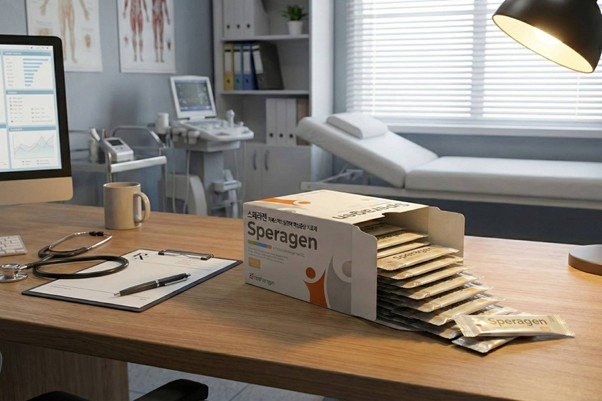 Astrogen is developing 'Speragen (AST-001),' a drug candidate for ASD / source=Astrogen Astrogen's core pipeline is the ASD treatment candidate, Speragen (AST-001). After investigator-initiated trials (IIT) from 2019 to 2021 verified Speragen's safety and efficacy, Astrogen completed four clinical trials (Phases 1, 2, 3, plus a Phase 2 extension study) between 2020 and 2024. In April 2024, Speragen was designated as an Orphan Drug in the Development Stage by the MFDS. Astrogen submitted its product approval application to the MFDS in June 2025 and is currently under review. Hwang noted, "This is considered a globally significant clinical trial case, as we confirmed long-term safety and core symptom improvement in the largest cohort of pediatric patients worldwide (320 patients in total)." A key factor enabling Astrogen's rapid progress in the challenging development of a core symptom treatment was Hwang's background in the clinical field. She stated, "I clearly understood what parts patients and caregivers struggled with the most." Notably, Astrogen focused on utilizing ingredients with proven safety profiles to minimize side effects. Hwang added, "We discovered a substance that could help improve sociality and communication. Since the substance's safety was already established, we were able to obtain approval from the Institutional Review Board (IRB) of university hospitals to conduct the investigator-initiated trial (IIT), which subsequently allowed us to proceed rapidly with formal clinical trials and shorten the approval timeline." Speragen differentiates itself by targeting the core symptoms of children with autism and being usable from the age of two. Hwang explained, "The brains of autistic children often suffer from inefficient Synaptic Pruning, where abnormally excessive synapses are not properly cleared. Speragen helps normalize this process by activating brain plasticity." She emphasized, "The pre-school age, when brain plasticity is most active, is the therapeutic golden hour where treatment effects are best. Clinical trials have confirmed cases where social skills recovered to within the normal range when the drug was administered during this period." The urgency of patients registering for the clinical trials, coupled with the observed effects of the new drug, is evident. Hwang shared, "A child who had never made eye contact finally looked at their parents for the first time, and a non-verbal child uttered their first words. Beyond core symptoms, patients' anxiety and sensitivity decreased, and overall daily life improved. Caregivers were so satisfied that some even submitted official statements to continue the drug's efficacy after the trial concluded." Beyond Drug Development: Extending Social Responsibility 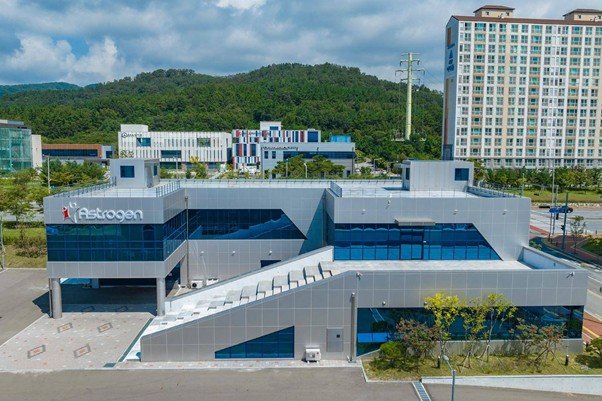 Astrogen aims for the long-term goal of caring for the entire lives of patients, both before and after drug administration, not just focusing on new drug development / source=Astrogen Astrogen’s long-term vision extends beyond drug development, aiming to care for the patient’s entire life journey, pre- and post-drug administration. To this end, the company launched 'Stellar Steps' in April this year, providing a free self-help and independent living education program for adolescents with autism and developmental disabilities. Hwang stated, "What children with severe developmental disabilities need most is not cognitive enhancement, but motivation for life and assistance in performing daily living skills." Stellar Steps helps participants practice essential daily skills, such as bathing, dressing, and performing simple household chores without the aid of a caregiver. Furthermore, the plan is to support job placement and offer caregivers time for emotional respite. Hwang pointed to the insufficient support systems available in adulthood. "According to statistics from the Korean Ministry of Health and Welfare (MOHW), the average lifespan of individuals with autism is 23.8 years, the shortest among all disabilities. This is significantly lower than in other developed countries (Sweden 53.8 years, Canada 46.2 years) and is influenced by vulnerable support systems post-adulthood." She then introduced a case of directly employing an individual with an autism disability, asserting, "Their expressive abilities, social skills, and cognitive functions can improve through living and interacting with people. It is crucial to provide an environment that fosters social skills without setting limits." Driving Follow-Up Pipeline Development: The Goal of 'Expanding Positive Influence' 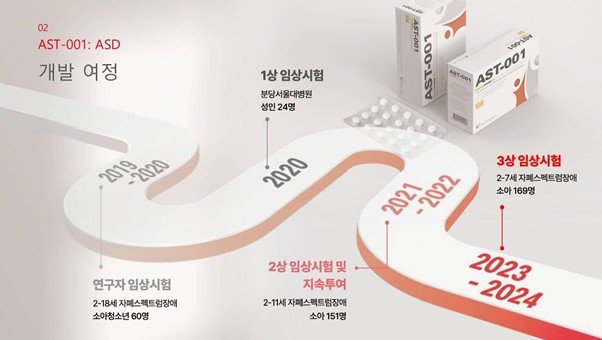 Speragen Development Journey / source=Astrogen Established in 2017, Astrogen is steadily growing, having been selected as a preliminary unicorn by the Korean Ministry of SMEs and Startups in September this year. Following the expected product approval of Speragen by the MFDS, the company aims for a domestic launch in the first half of 2026. Global expansion is also underway, including into the US, China, and the Middle East. Notably, the company is negotiating a large-scale contract with a major pharmaceutical distributor for entry into the Middle Eastern market, which is seeing active, government-led, large-scale health investments. Astrogen is systematically expanding its follow-up pipeline across central nervous system (CNS) disorders and is preparing for an Initial Public Offering (IPO). Recognizing that 80% of autism patients also have ADHD, the company is developing a non-stimulant ADHD treatment with fewer side effects, targeting clinical entry in 2026. It is also pursuing treatments for intractable neurological diseases such as Rett Syndrome and Parkinson’s disease. Astrogen’s growth has been supported by the Seoul Startup Hub under the Seoul Business Agency (SBA). Hwang acknowledged, "The Seoul Startup Hub provided practical workspace for our Seoul-based employees and laid the groundwork necessary for startup growth through acceleration, education, and consulting. It also offered opportunities for collaboration and growth with other resident companies." Finally, Hwang emphasized her vision to make growth not just a financial metric but an "expansion of positive influence." She concluded, "Astrogen seeks to restore ordinary daily life to patients and families not only through new drug development but also through social connection that supports adolescents and caregivers with developmental disabilities. We will be a company that consistently builds the connection between science and people, filling the gaps." By Ye-ji Kim (yj@itdonga.com) URL : https://www.donga.com/en/article/all/20251217/6015589/1 * This article was written with support from SBA and Seoul City. |
|||
| PREV | |
|---|---|
| NEXT | Astrogen and Cigalah Sign Exclusive MENA Partnership for AST-001 in a Deal Valued at up to USD 209 Million Plus Royalties |